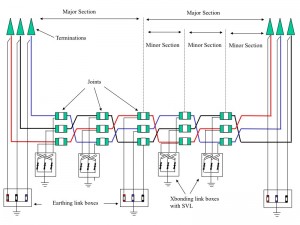
The current that flows in the phase conductors, induce voltages in the cables screens. The level of the induced voltages depend on several factors, which can be summarized as:
- Current flowing through the conductor,
- the length of the circuit,
- the mutual inductance between conductors and screens, which is related to the separation of the single core cables and the screen radius.
The current flows through the screen when it is connected forming a closed circuit.
 As we increase the voltage (45kV, 66kV, 132kV, 220kV, …) to minimize the circulating currents in the cables is crucial to achieve a greater transport capacity.
One way to avoid the circulating currents in the screen, is to ground the cable screen a single point and isolate all other parts of the screen from earth (single-point or end-point connection) thus avoiding the current flow through the screens.
If the screens are connected to earth in only one point, then they are subjected to a variable voltage, with a value of zero in the earthing point and with a maximum value in the farthest point from this connection.
This voltage is proportional to the current flowing through the conductor, and it is influenced bye the spacing between the cables.
To protect the insulation of the screen against transient voltages resulting from lightning or switching transients, it is necessary to put voltage limiters on the screen (SVLs, Sheath Voltage Limiters) on all joints and end positions where screen is floating.
In general, it is possible to define four basic possibilities for cable screen connection:
- Direct to earth in all points – Solidly bonded –
- Earth connection in one single point in one end (single point or end point boding)
- Earth connection in one middle point (double single point or mid point bonding)
- Cross-bonding