
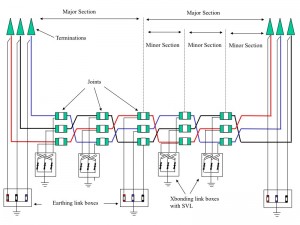
Other connection systems mentioned in other articles (double single point, single point or screens solidly bonded) are valid for relatively short lengths. But for long lengths, the cross-bonding system must be used. In this case, the route is divided into major sections, each of which is divided into three subsections or minor sections.
Every three joints, the screens have to be connected directly to earth, and in the two intermediate joints, the screens have to be crossed according to figure above and will be isolated from earth via SVLs.
The three screens connected in series are associated with conductors of different phases, and when the cables are installed in a trefoil formation, their currents, and consequently the voltages of the screens have the same magnitude but with a phase shift of 120 °. The overall effect is that the resultant voltage and the current in the three screens are zero.
When the cables are placed in flat formation, the voltages induced in the outer cable’s screens are greater than those induced in the middle cable screen and the sum of the factors is not zero.
For this reason, in flat formation, it is necessary to transpose the cables at each joint point and the crossing is performed with a phase rotation opposite to that of the transposed so that the screens are connected straight, for example the middle cable screen of the section 1 is connected with the middle cable screen of the section 2 and so on. Thus the factor sum of the voltage of the screen on three successive minor sections is again zero.
The cross-bonding system does not need a earthing connecting cable as the screens are continuously connected and it is only necessary to connect them to the ends of each major section.